
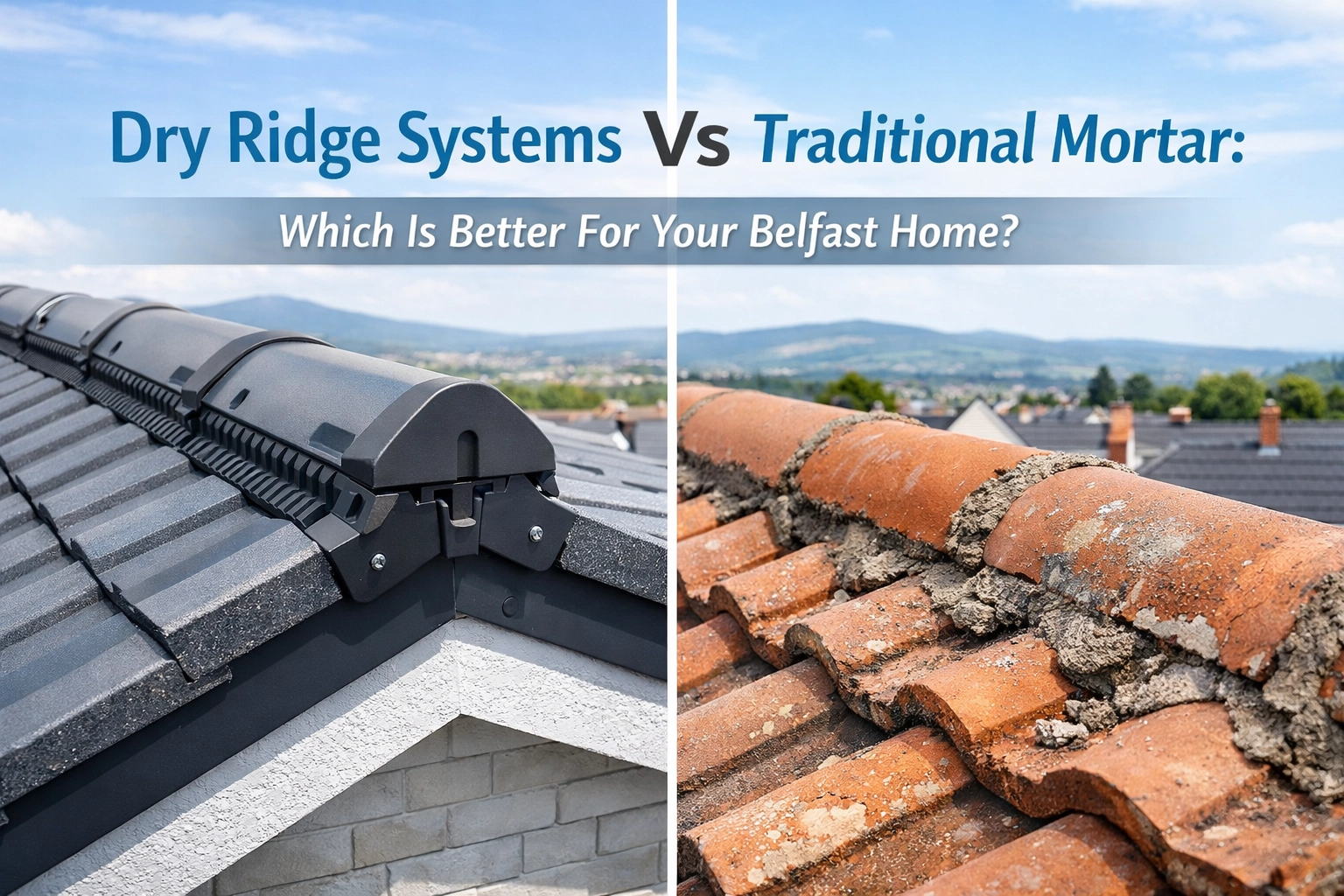

If you're planning roof work in Belfast or dealing with failing ridge tiles, you've probably heard conflicting advice about dry ridge systems versus traditional mortar. Some roofers swear by the old methods. Others push modern alternatives. So which is actually better for your home?
The honest answer: for most Belfast homeowners, dry ridge systems are the superior long-term choice. They save money, require virtually no maintenance, and stand up to Northern Ireland's weather far better than mortar ever could.
But that doesn't mean mortar is always wrong. If you own a period property or live in a conservation area, traditional methods might be your best (or only) option.
Let's break down the real differences, costs, and when each system makes sense for Belfast homes.
What Are Dry Ridge Systems?
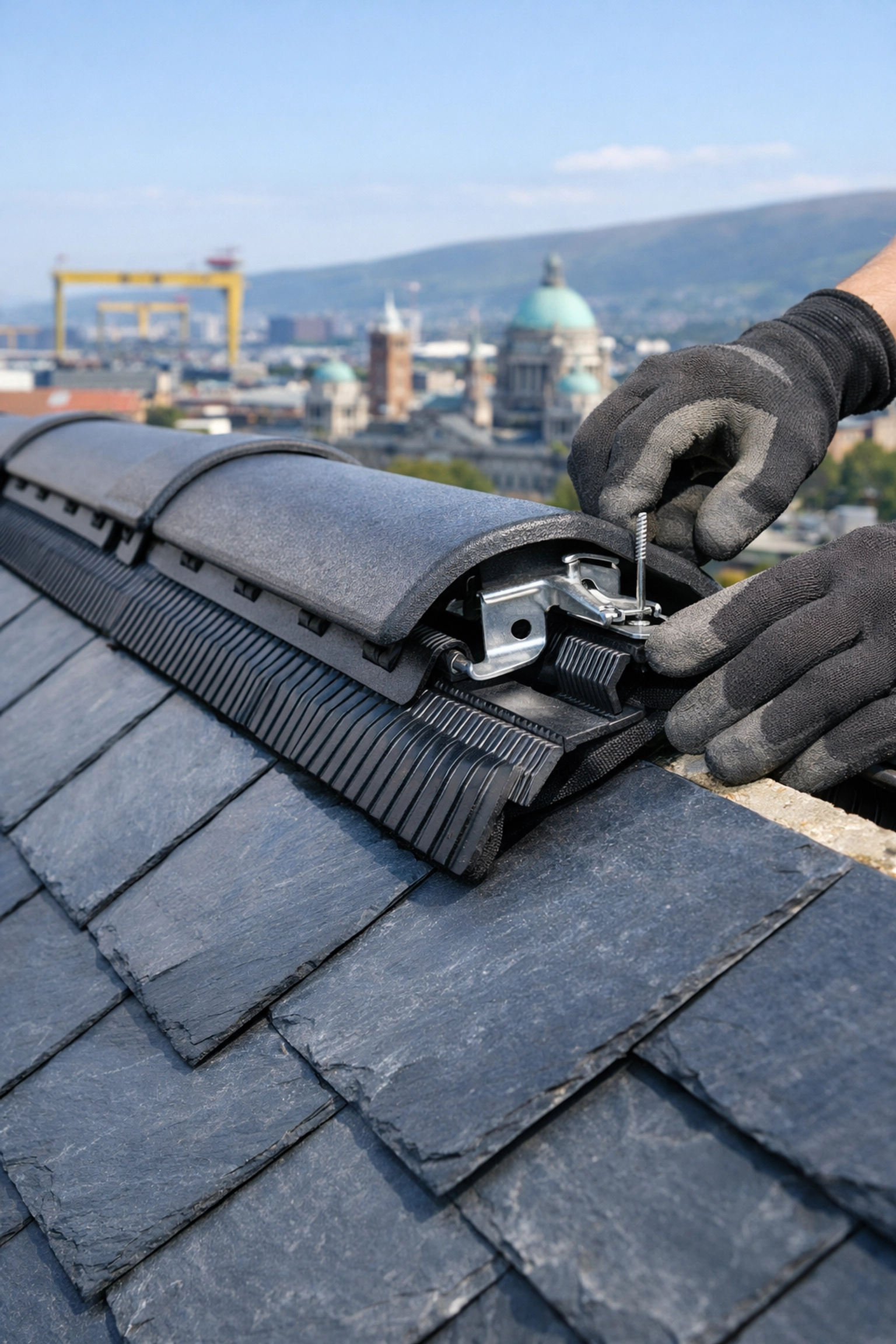
Dry ridge systems use mechanical fixings: screws, clips, and purpose-built brackets: to secure ridge tiles directly to your roof structure. No mortar. No cement. Just engineered components that lock everything in place.
The tiles sit on a roll-out ridge unit that runs along the apex of your roof. Ventilation gaps are built into the design, allowing continuous airflow through your roof space while keeping wind and rain out.
Modern dry ridge systems are designed to withstand wind speeds up to 100mph: more than enough for Belfast's worst winter storms.
What Is Traditional Mortar Bedding?
Traditional mortar bedding is the old-school method: ridge tiles are set into a bed of sand and cement mixture, then pointed along the joints. The mortar holds the tiles in place through adhesion and weight.
When done properly by a skilled roofer, mortar bedding creates a sculpted, traditional finish that suits heritage properties and period homes beautifully. It's been used for over a century across Belfast's Victorian terraces and Edwardian villas.
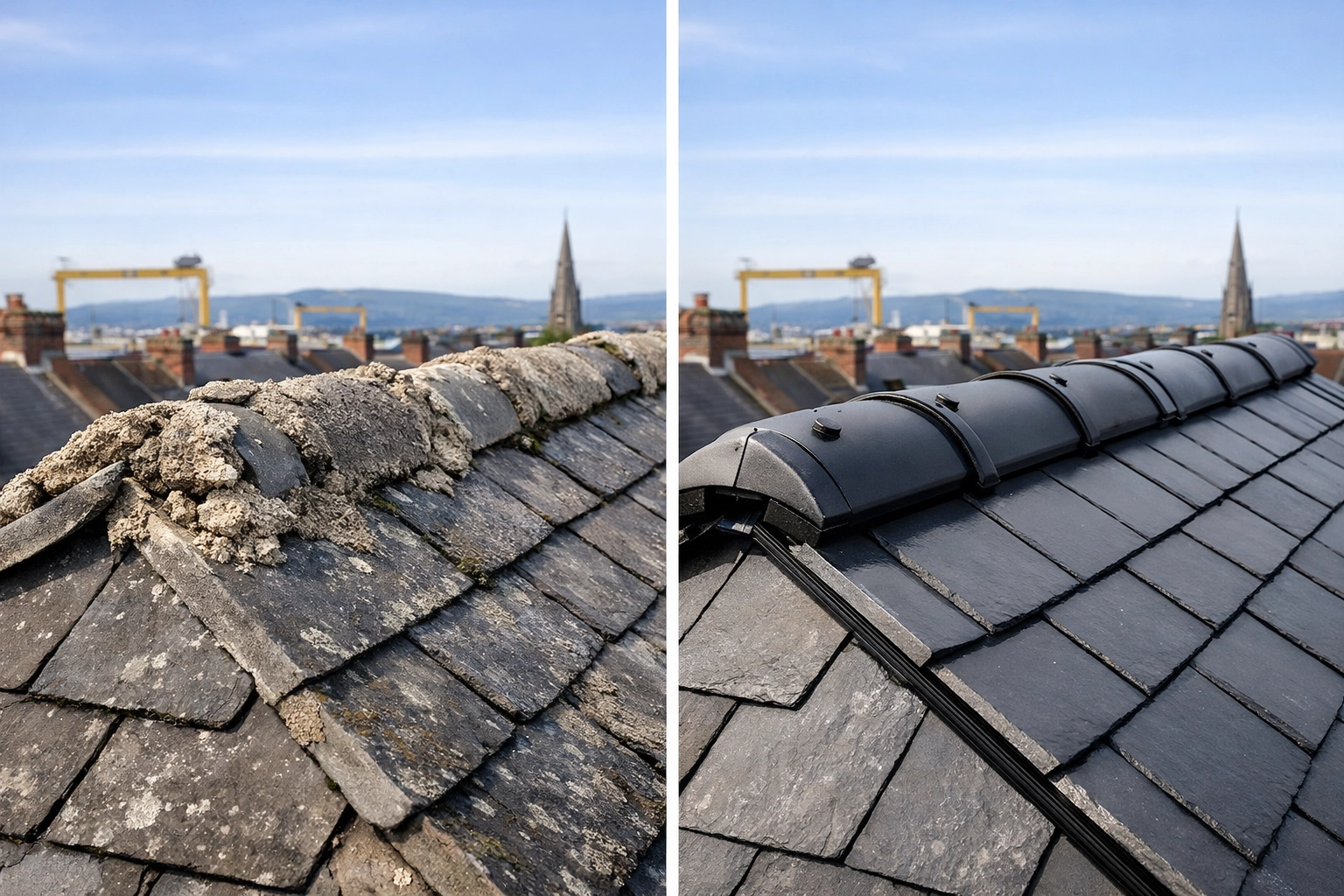
The problem? Mortar is rigid, porous, and vulnerable to our weather.
The Belfast Weather Challenge: Why It Matters
Belfast's climate is brutal on roof mortar. We don't just get rain: we get driving rain at an angle, often combined with high winds. Freeze-thaw cycles in winter are particularly damaging.
Here's what happens:
- Water seeps into microscopic cracks in the mortar
- When temperatures drop, that water freezes and expands
- The expansion widens the cracks
- When it thaws, more water gets in
- The cycle repeats: and the damage accelerates
Most mortar ridges in Belfast show significant deterioration within 10–15 years. Exposed properties or homes on hillsides often see damage even sooner.
Dry ridge systems eliminate this problem entirely. There's no mortar to crack, no water ingress to cause freeze damage, and no deterioration from thermal expansion and contraction.
Key Benefits of Dry Ridge Systems for Belfast Homes
Wind Resistance That Actually Works
Dry ridge systems are mechanically fixed to your roof structure with screws and brackets. That means they're physically bolted down: not just stuck with cement.
When high winds hit (and they will in Belfast), the mechanical fixings resist uplift forces that would pull mortar-bedded tiles loose. Where mortar relies on a bond that weakens over time, dry ridge maintains full strength year after year.
Virtually Maintenance-Free for 50 Years
This is the biggest long-term advantage. Dry ridge systems are estimated to remain maintenance-free for up to 50 years.
Compare that to mortar, which typically needs:
- Inspection and minor repairs every 5–7 years
- Full repointing every 10–15 years
- Emergency repairs after particularly bad storms
Over the life of your roof, that's multiple rounds of scaffolding costs, labour charges, and material expenses: all avoided with dry ridge.

Faster Installation Means Lower Labour Costs
Dry ridge takes approximately 2.5 hours per 10 metres of ridge to install. Traditional mortar bedding takes around 6 hours for the same length: more than twice as long.
Less time on site means lower labour costs. It also means less disruption to your home, less time with scaffolding up, and faster project completion.
Natural Flexibility Without Cracking
Your roof structure naturally expands and contracts with temperature changes throughout the year. It's physics: materials expand when hot and contract when cold.
Rigid mortar cracks under this constant movement. Dry ridge systems accommodate the movement through their mechanical fixings and flexible components, maintaining a weatherproof seal without compromising integrity.
Built-In Ventilation Prevents Condensation
Dry ridge systems facilitate continuous air circulation along the ridge line. This keeps your roof structure dry, prevents condensation build-up in the loft space, and helps maintain healthy roof timbers.
Mortar bedding blocks airflow completely. While you can add separate ventilation, it's never as effective as the integrated ventilation built into dry ridge systems.
When Does Traditional Mortar Make Sense?
Despite dry ridge's advantages, there are legitimate situations where traditional mortar is the right choice:
Period Properties and Heritage Homes
If you own a Victorian terrace, Edwardian villa, or listed building in Belfast, aesthetics matter. Mortar bedding creates a traditional, sculpted appearance that suits the character of older properties.
A skilled roofer can create beautiful, durable mortar work that complements your home's original features while lasting longer than poor-quality modern alternatives.
Conservation Area Requirements
Some conservation areas in Belfast have strict guidelines requiring original building materials and construction methods. You may need planning approval before switching from mortar to a dry ridge system.
Check with your local council before committing to either option if you live in a designated conservation area.
Existing Mortar in Good Condition
If your current mortar ridge is in genuinely good condition and only needs minor pointing repairs, a full replacement might not be justified. Sometimes a targeted repair is the most cost-effective solution.
That said, if you're seeing cracks, loose tiles, or recurring leaks, it's often better to upgrade to dry ridge during the repair rather than throwing good money after bad on deteriorating mortar.
Cost Comparison: What You'll Actually Spend
Upfront installation: Dry ridge systems typically cost £80–£120 per metre installed. Traditional mortar bedding costs £60–£90 per metre: cheaper initially, but that's not the full picture.
Long-term costs over 20 years:
- Dry ridge: Installation cost + minimal to zero maintenance = £1,200–£1,800 total (for a typical 15-metre ridge)
- Mortar: Installation + repointing every 10–15 years + periodic repairs = £1,600–£2,500 total
That's a saving of £400–£700 over 20 years with dry ridge: and that's assuming your mortar doesn't need emergency storm repairs, which many Belfast homes do.
The difference becomes even more significant if you factor in the hassle, disruption, and stress of repeated scaffolding jobs versus one installation that lasts decades.
Which System Should You Choose for Your Belfast Home?
Choose dry ridge systems if:
- You want minimal maintenance and long-term savings
- Your property is in an exposed or wind-prone area
- You're having new roof work done or replacing an existing roof
- You've experienced repeated mortar failures
- You value modern engineering and proven weather resistance
Choose traditional mortar if:
- You own a period property where aesthetics and character matter
- You live in a conservation area with restrictions on materials
- Your existing mortar is in genuinely good condition and only needs minor repairs
- You're matching existing work on a partial roof section
For the majority of Belfast homeowners: particularly those with post-war properties, modern builds, or roofs that have suffered repeated mortar failures: dry ridge is the clear winner.
Get Expert Advice for Your Roof
Not sure which system is right for your Belfast home? We can assess your property, explain your options honestly, and provide a clear quote for either system.
At Advanced Construction & Roofing, we install both dry ridge systems and traditional mortar bedding across Belfast: and we'll recommend what actually makes sense for your specific situation, not just what's easier for us.
Request a free quote: https://adv-group.co.uk
We'll inspect your ridge, discuss your priorities (cost, aesthetics, maintenance), and give you straightforward advice on the best long-term solution for your home.