Is Your Loft Too Hot (Or Too Cold)? Here's the Truth About Roof Ventilation

If your loft feels like a sauna in summer or a damp cave in winter, you've got a ventilation problem. And in Northern Ireland's damp climate, poor roof ventilation doesn't just make your home uncomfortable, it actively damages your roof structure, feeds mould growth, and costs you money in wasted heating.

Here's what you need to know about roof ventilation, why it matters more in Belfast, Bangor, and Newtownards than almost anywhere else in the UK, and how to spot the warning signs before they turn into expensive repairs.

The Warning Signs: Is Your Roof Ventilation Failing?

Poor roof ventilation doesn't always announce itself with dramatic leaks. More often, it creeps in quietly through condensation, damp patches, and structural damage that builds over months and years.

Watch for these signs:

Condensation on windows and walls in upstairs rooms. If moisture is pooling on glass or running down walls near the roofline, warm air is hitting cold surfaces, and that means your loft isn't breathing properly.

Black mould spots on ceilings or in roof spaces. Mould needs three things: moisture, warmth, and poor airflow. A badly ventilated loft gives it all three. If you're seeing black spots in corners or along the eaves, your roof ventilation has likely failed.

Damp or musty smell in the loft. Walk into your loft space. If it smells damp, feels clammy, or has that distinctive "old attic" odour, trapped moisture is sitting in the timbers and insulation.

Water stains or wet insulation. Check your loft insulation. If it's damp to the touch, compressed, or showing water stains, condensation is forming inside the roof space, not from a leak, but from poor ventilation.

Extreme temperature swings. A loft that's scorching hot in summer and freezing in winter suggests airflow isn't regulating temperature properly. In Northern Ireland, where we rarely see extreme heat, the cold and damp side of this equation does most of the damage.

Frost on the underside of roof tiles in winter. If you see frost forming on the inside of your roof during cold snaps, warm moist air is condensing and freezing on cold surfaces. That's a textbook ventilation failure.
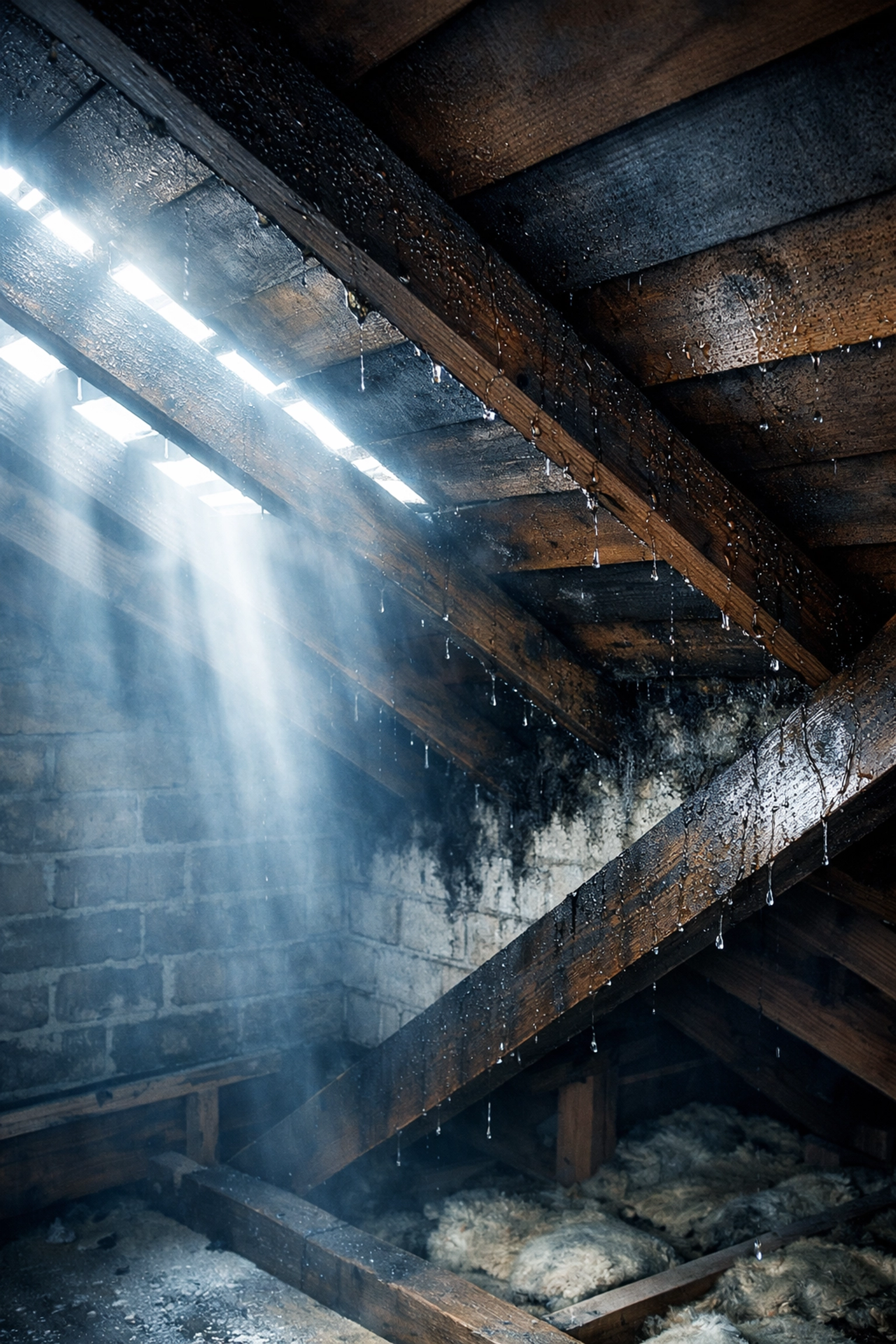
Condensation and black mould in loft rafters caused by poor roof ventilation

Why Northern Ireland's Climate Makes Roof Ventilation Critical

Northern Ireland's weather is mild, wet, and humid for much of the year. We don't get the baking summers that drive ventilation concerns in southern England or the deep freezes that cause ice dam problems in Scotland. But we do get something worse for roofs: constant dampness.

Average humidity in Belfast sits between 75% and 85% year-round. That moisture-laden air doesn't just sit outside, it moves into your home, rises into the loft, and condenses on cold surfaces when it meets your roof structure.

Without adequate roof ventilation, that moisture has nowhere to go. It sits in your roof timbers, soaks into insulation, and creates the perfect environment for:

  • Wood rot in roof joists and rafters
  • Mould and mildew growth
  • Insulation breakdown (wet insulation loses most of its thermal efficiency)
  • Rust and corrosion on metal fixings, brackets, and flashing

In drier climates, occasional moisture might evaporate naturally. In Northern Ireland, it just builds. Roof ventilation is your only reliable way to move that damp air out before it causes structural damage.

How Proper Roof Ventilation Actually Works

Roof ventilation isn't about "letting heat escape" or "making your home colder." It's about creating continuous airflow through the loft space to regulate temperature and remove moisture.

A properly designed ventilation system uses two types of vents working together:

Intake vents (usually soffit vents along the eaves) pull fresh air into the loft space from outside. These sit at the lowest point of the roof, where cool air naturally enters.

Exhaust vents (ridge vents along the roof peak, or tile vents on the roof slope) allow warm, moist air to escape at the highest point. Hot air rises naturally, so exhaust vents positioned at the ridge let that air exit without needing mechanical help.

When these two work together in a balanced system, roughly equal intake and exhaust capacity, you get continuous airflow. Cool air enters at the eaves, warms as it picks up moisture, and exits at the ridge. The cycle repeats passively, 24 hours a day.

This process does two things:

  1. Removes moisture before it condenses. Instead of warm, damp air hitting cold roof surfaces and turning into water droplets, airflow moves it out before condensation forms.

  2. Regulates temperature. In summer, ventilation stops heat from building up to extreme levels (though in Northern Ireland, this is less of a concern). In winter, it keeps the loft cold and dry, which prevents condensation and protects insulation efficiency.

How Roof Ventilation Protects Your Roof Structure

Roof timbers are designed to carry load and shed water from the outside. They're not designed to sit in damp, stagnant air for years on end.

When roof ventilation fails, moisture accumulates in the loft space and creates conditions that actively damage the structure:

Wood rot and decay. Roof joists, rafters, and purlins need dry air to stay strong. Prolonged exposure to damp air encourages fungal growth, which breaks down the timber fibres and weakens the structure. Once rot takes hold, timbers lose their load-bearing capacity and need replacing, an expensive job that involves stripping sections of the roof.

Nail sickness. The metal fixings, brackets, and nails that hold your roof together corrode faster in damp environments. Rusted nails lose their grip, and over time, slates and tiles can work loose. This is a common problem in poorly ventilated roofs across Belfast and Bangor.

Insulation failure. Most loft insulation (fibreglass, mineral wool, cellulose) loses thermal performance when it gets damp. Wet insulation compresses, stops trapping air pockets, and can lose up to 50% of its R-value. That means you're paying more to heat your home while your roof structure sits in a damp, cold environment, exactly the conditions that accelerate decay.

Roof membrane damage. Many modern roofs use breathable membranes under the tiles to manage moisture. These membranes are designed to let water vapour escape outward while blocking liquid water from entering. But if your loft ventilation is blocked or inadequate, moisture can build up against the membrane and overwhelm its capacity. Over time, this leads to water tracking into the roof timbers and insulation.

Proper roof ventilation prevents all of this by keeping the loft environment dry, stable, and at a temperature close to the outside air. Your roof structure stays sound, your insulation works efficiently, and you avoid the kind of slow structural damage that's expensive to fix.

Advanced Construction & Roofing Roof Survey Service

What Good Roof Ventilation Looks Like

If you're checking your own roof ventilation or getting a professional assessment, here's what a properly designed system includes:

Balanced intake and exhaust. For every square foot of exhaust vent (ridge or tile vents), you need roughly equal intake area (soffit vents). Too much exhaust without enough intake means the system works inefficiently. Too much intake without enough exhaust traps moist air in the loft.

No blocked vents. Soffit vents get blocked by insulation, debris, or old paint. Tile vents get clogged with moss or nests. Check that all vents are clear and allowing airflow.

Continuous airflow path. Air needs to move freely from eaves to ridge without obstruction. If loft insulation is pushed tight against the eaves, it blocks the intake vents. If there's no gap between insulation and the roof deck, airflow can't move through the space.

Appropriate vent size for the loft area. Building regulations recommend a minimum of 10mm continuous ventilation gap at eaves level for roofs with a pitch over 15 degrees. For steeper roofs or larger loft spaces, you'll need more.

No competing ventilation systems. Mixing different vent types (e.g., powered attic fans with passive ridge vents) can disrupt airflow and create negative pressure zones. Stick with one properly balanced system.

If your roof was built or re-roofed in the last 20 years, it should have ventilation designed in. Older roofs, especially pre-1990s builds, often have inadequate or blocked ventilation that needs upgrading.

Roof ventilation system showing airflow from soffit vents to ridge vents

Roof Ventilation Myths (And What Actually Matters)

"Ventilation makes my house colder in winter." No. Proper ventilation keeps your loft cold, which is what you want. Your insulation sits on the floor of the loft, separating the cold loft space from the warm living space below. A cold, dry, ventilated loft is more thermally efficient than a warm, damp, poorly ventilated one.

"I don't need ventilation because I have breathable roofing felt." Breathable membranes help, but they're not a substitute for ventilation. They manage moisture vapour, but they don't remove the volume of damp air that builds up in Northern Ireland's humid climate. You still need airflow.

"More vents are always better." Not necessarily. Unbalanced ventilation (too many exhaust vents, not enough intake) creates turbulence and reduces efficiency. What matters is balance and proper placement.

What To Do If You Suspect Poor Roof Ventilation

If you're seeing condensation, mould, damp timbers, or musty smells in your loft, don't ignore it. These problems get worse over time, and the longer moisture sits in your roof structure, the more expensive the repairs become.

Request a roof survey. A professional inspection will identify whether your ventilation system is adequate, balanced, and clear of blockages. We'll check soffit vents, ridge vents, airflow paths, and the condition of your roof timbers and insulation.

Get a clear assessment and quote. If ventilation upgrades are needed: whether that's installing new ridge vents, clearing blocked soffits, or adding tile vents: we'll explain what's required and why. No jargon, no overselling.

Consider ventilation alongside other roof work. If you're already planning roof repairs, re-roofing, or loft insulation upgrades, that's the ideal time to improve ventilation. The roof is open, access is easier, and the work integrates seamlessly.

We work across Belfast, Bangor, Newtownards, and throughout Northern Ireland, and we've seen every type of ventilation failure that our damp climate can cause. If your loft's too hot, too cold, or showing signs of moisture damage, contact us for a roof survey and honest advice.

Get in touch: https://adv-group.co.uk

Your roof is designed to last decades: but only if it can breathe properly. Don't let poor ventilation shorten its life.

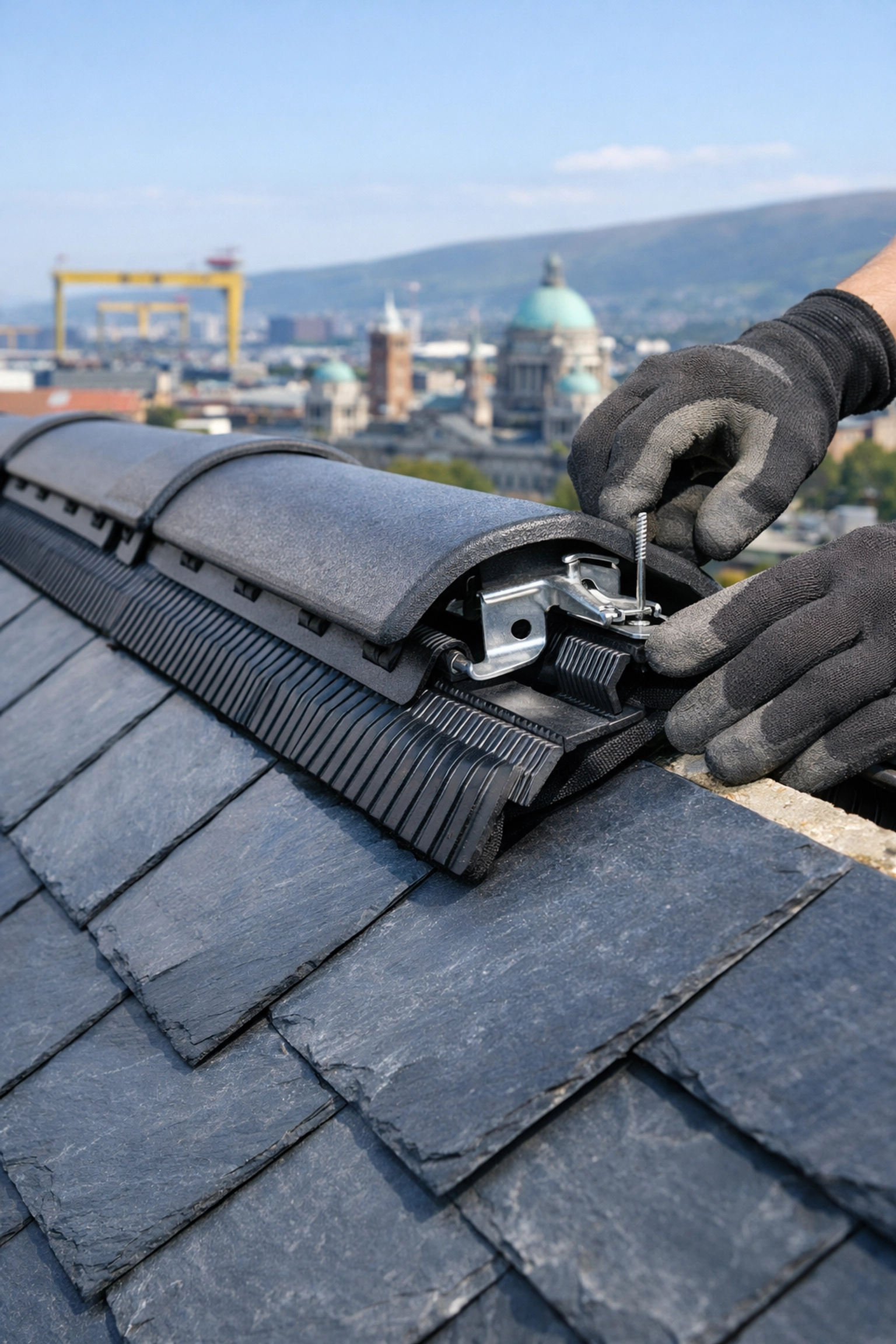
Dry Ridge Systems Vs Traditional Mortar: Which Is Better For Your Belfast Home?

If you're planning roof work in Belfast or dealing with failing ridge tiles, you've probably heard conflicting advice about dry ridge systems versus traditional mortar. Some roofers swear by the old methods. Others push modern alternatives. So which is actually better for your home?

The honest answer: for most Belfast homeowners, dry ridge systems are the superior long-term choice. They save money, require virtually no maintenance, and stand up to Northern Ireland's weather far better than mortar ever could.

But that doesn't mean mortar is always wrong. If you own a period property or live in a conservation area, traditional methods might be your best (or only) option.

Let's break down the real differences, costs, and when each system makes sense for Belfast homes.

What Are Dry Ridge Systems?

Dry ridge systems use mechanical fixings: screws, clips, and purpose-built brackets: to secure ridge tiles directly to your roof structure. No mortar. No cement. Just engineered components that lock everything in place.

The tiles sit on a roll-out ridge unit that runs along the apex of your roof. Ventilation gaps are built into the design, allowing continuous airflow through your roof space while keeping wind and rain out.

Modern dry ridge systems are designed to withstand wind speeds up to 100mph: more than enough for Belfast's worst winter storms.

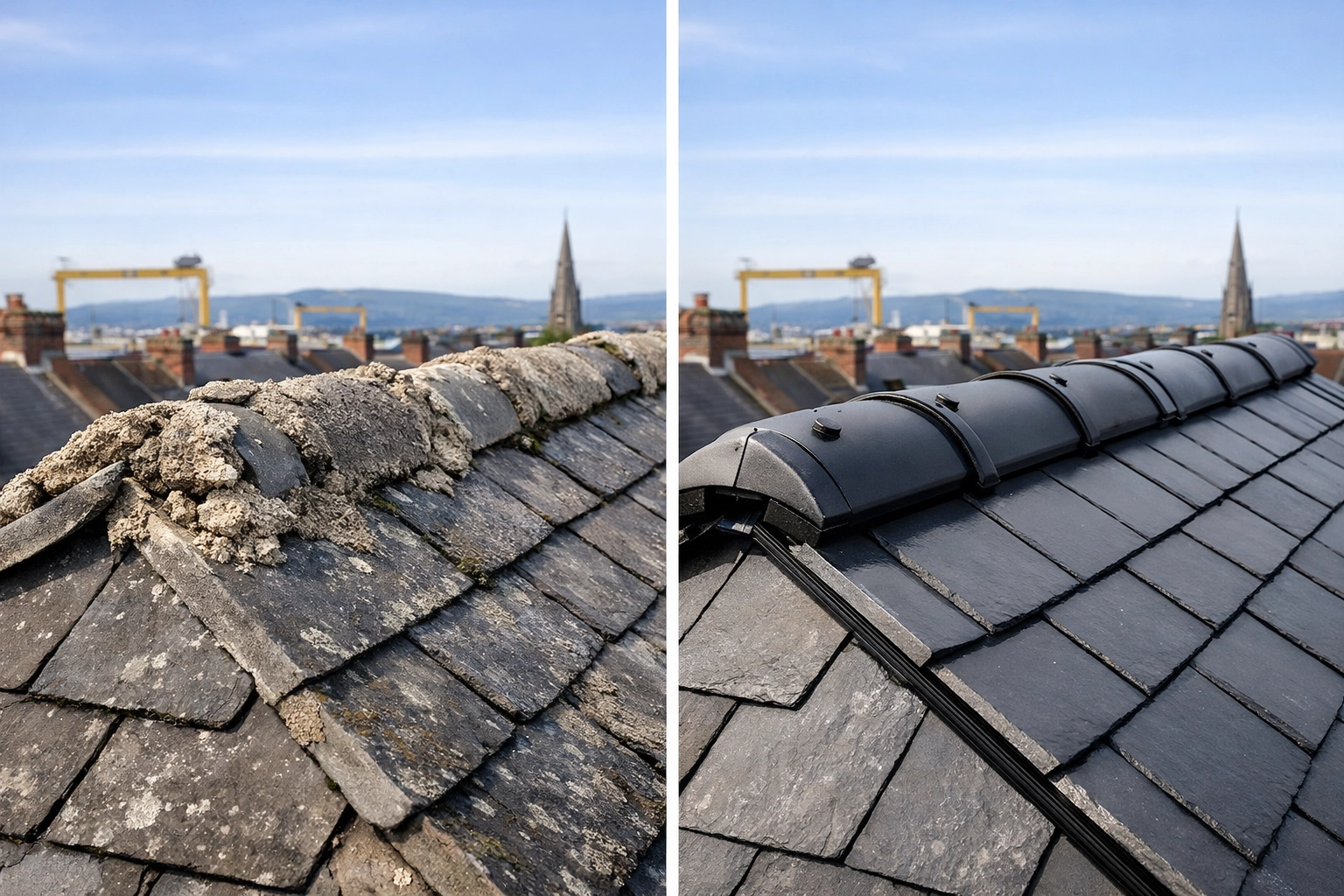
Roofer installing dry ridge system with mechanical fixings on Belfast slate roof

What Is Traditional Mortar Bedding?

Traditional mortar bedding is the old-school method: ridge tiles are set into a bed of sand and cement mixture, then pointed along the joints. The mortar holds the tiles in place through adhesion and weight.

When done properly by a skilled roofer, mortar bedding creates a sculpted, traditional finish that suits heritage properties and period homes beautifully. It's been used for over a century across Belfast's Victorian terraces and Edwardian villas.

The problem? Mortar is rigid, porous, and vulnerable to our weather.

The Belfast Weather Challenge: Why It Matters

Belfast's climate is brutal on roof mortar. We don't just get rain: we get driving rain at an angle, often combined with high winds. Freeze-thaw cycles in winter are particularly damaging.

Here's what happens:

  1. Water seeps into microscopic cracks in the mortar
  2. When temperatures drop, that water freezes and expands
  3. The expansion widens the cracks
  4. When it thaws, more water gets in
  5. The cycle repeats: and the damage accelerates

Most mortar ridges in Belfast show significant deterioration within 10–15 years. Exposed properties or homes on hillsides often see damage even sooner.

Dry ridge systems eliminate this problem entirely. There's no mortar to crack, no water ingress to cause freeze damage, and no deterioration from thermal expansion and contraction.

Key Benefits of Dry Ridge Systems for Belfast Homes

Wind Resistance That Actually Works

Dry ridge systems are mechanically fixed to your roof structure with screws and brackets. That means they're physically bolted down: not just stuck with cement.

When high winds hit (and they will in Belfast), the mechanical fixings resist uplift forces that would pull mortar-bedded tiles loose. Where mortar relies on a bond that weakens over time, dry ridge maintains full strength year after year.

Virtually Maintenance-Free for 50 Years

This is the biggest long-term advantage. Dry ridge systems are estimated to remain maintenance-free for up to 50 years.

Compare that to mortar, which typically needs:

  • Inspection and minor repairs every 5–7 years
  • Full repointing every 10–15 years
  • Emergency repairs after particularly bad storms

Over the life of your roof, that's multiple rounds of scaffolding costs, labour charges, and material expenses: all avoided with dry ridge.

Roofer Roof Inspection in Rain

Faster Installation Means Lower Labour Costs

Dry ridge takes approximately 2.5 hours per 10 metres of ridge to install. Traditional mortar bedding takes around 6 hours for the same length: more than twice as long.

Less time on site means lower labour costs. It also means less disruption to your home, less time with scaffolding up, and faster project completion.

Natural Flexibility Without Cracking

Your roof structure naturally expands and contracts with temperature changes throughout the year. It's physics: materials expand when hot and contract when cold.

Rigid mortar cracks under this constant movement. Dry ridge systems accommodate the movement through their mechanical fixings and flexible components, maintaining a weatherproof seal without compromising integrity.

Built-In Ventilation Prevents Condensation

Dry ridge systems facilitate continuous air circulation along the ridge line. This keeps your roof structure dry, prevents condensation build-up in the loft space, and helps maintain healthy roof timbers.

Mortar bedding blocks airflow completely. While you can add separate ventilation, it's never as effective as the integrated ventilation built into dry ridge systems.

When Does Traditional Mortar Make Sense?

Despite dry ridge's advantages, there are legitimate situations where traditional mortar is the right choice:

Period Properties and Heritage Homes

If you own a Victorian terrace, Edwardian villa, or listed building in Belfast, aesthetics matter. Mortar bedding creates a traditional, sculpted appearance that suits the character of older properties.

A skilled roofer can create beautiful, durable mortar work that complements your home's original features while lasting longer than poor-quality modern alternatives.

Conservation Area Requirements

Some conservation areas in Belfast have strict guidelines requiring original building materials and construction methods. You may need planning approval before switching from mortar to a dry ridge system.

Check with your local council before committing to either option if you live in a designated conservation area.

Existing Mortar in Good Condition

If your current mortar ridge is in genuinely good condition and only needs minor pointing repairs, a full replacement might not be justified. Sometimes a targeted repair is the most cost-effective solution.

That said, if you're seeing cracks, loose tiles, or recurring leaks, it's often better to upgrade to dry ridge during the repair rather than throwing good money after bad on deteriorating mortar.

Comparison of cracked mortar ridge versus modern dry ridge system on Belfast roofs

Cost Comparison: What You'll Actually Spend

Upfront installation: Dry ridge systems typically cost £80–£120 per metre installed. Traditional mortar bedding costs £60–£90 per metre: cheaper initially, but that's not the full picture.

Long-term costs over 20 years:

  • Dry ridge: Installation cost + minimal to zero maintenance = £1,200–£1,800 total (for a typical 15-metre ridge)
  • Mortar: Installation + repointing every 10–15 years + periodic repairs = £1,600–£2,500 total

That's a saving of £400–£700 over 20 years with dry ridge: and that's assuming your mortar doesn't need emergency storm repairs, which many Belfast homes do.

The difference becomes even more significant if you factor in the hassle, disruption, and stress of repeated scaffolding jobs versus one installation that lasts decades.

Which System Should You Choose for Your Belfast Home?

Choose dry ridge systems if:

  • You want minimal maintenance and long-term savings
  • Your property is in an exposed or wind-prone area
  • You're having new roof work done or replacing an existing roof
  • You've experienced repeated mortar failures
  • You value modern engineering and proven weather resistance

Choose traditional mortar if:

  • You own a period property where aesthetics and character matter
  • You live in a conservation area with restrictions on materials
  • Your existing mortar is in genuinely good condition and only needs minor repairs
  • You're matching existing work on a partial roof section

For the majority of Belfast homeowners: particularly those with post-war properties, modern builds, or roofs that have suffered repeated mortar failures: dry ridge is the clear winner.

Get Expert Advice for Your Roof

Not sure which system is right for your Belfast home? We can assess your property, explain your options honestly, and provide a clear quote for either system.

At Advanced Construction & Roofing, we install both dry ridge systems and traditional mortar bedding across Belfast: and we'll recommend what actually makes sense for your specific situation, not just what's easier for us.

Request a free quote: https://adv-group.co.uk

We'll inspect your ridge, discuss your priorities (cost, aesthetics, maintenance), and give you straightforward advice on the best long-term solution for your home.

Roof Surveys 101: A Beginner's Guide to Mastering Home Inspections in Northern Ireland

If you're buying a house in Belfast, Bangor, or Newtownards, the roof probably isn't the first thing on your mind. But here's the reality: your roof is one of the most expensive parts of your property to replace, and ignoring it can cost you thousands down the line.

A proper roof survey tells you exactly what you're dealing with: before you sign on the dotted line, before water starts dripping into your bedroom, and before a small repair turns into a full replacement job.

This guide walks you through everything you need to know about roof surveys in Northern Ireland, what we look for, and why getting one could save you serious money and stress.

What Actually Is a Roof Survey?

A roof survey is a full inspection of your roofing system: not just a quick glance from the ground. It examines the visible surface (tiles, slates, membrane), the structure beneath (timbers, decking), and all the surrounding features like gutters, chimneys, flashing, and ventilation.

Think of it as a health check for your roof. We're not just looking for obvious damage: we're identifying early warning signs that could lead to bigger problems if left unchecked.

Here's what a comprehensive roof survey covers:

  • Condition of tiles, slates, or flat roof membrane
  • Structural integrity of timbers and roof deck
  • Leadwork around chimneys, pipes, and skylights
  • Soffits, fascias, and bargeboards
  • Guttering and drainage systems
  • Ventilation and moisture management
  • Signs of rot, damp, or insulation issues

For flat roofs, we may take core samples: small sections extracted from the roof: to check what's happening beneath the surface. This tells us the roof deck material, whether moisture is trapped inside, and if the membrane is failing.

Advanced Construction & Roofing Roof Survey Service A professional roof inspector examines ceiling damage and insulation while taking notes. The image promotes Advanced Construction & Roofing's roof survey service, offering visual surveys, photo evidence, defect identification, and in-depth analysis for property owners. Contact details and a website link are included for booking a survey.

Why Do You Need a Roof Survey?

For Buyers

If you're buying a property in Belfast, Bangor, or Newtownards, a roof survey gives you serious negotiating power. Finding out the roof needs £8,000 worth of work after you've bought the house is a nightmare scenario you can avoid.

A survey tells you:

  • Whether the roof needs immediate work
  • If repairs can wait a few years
  • What the likely replacement cost will be
  • If there are hidden structural issues

Armed with this information, you can negotiate the sale price, ask the seller to fix issues before completion, or budget properly for upcoming work.

For Sellers

If you're selling, getting a roof survey done before listing your property shows buyers you're transparent and have nothing to hide. It can actually speed up the sale process because buyers won't need to request their own survey, and you can address any issues proactively.

For Existing Homeowners

Even if you're not buying or selling, a roof survey is smart maintenance. Northern Ireland weather is brutal on roofs: wind, rain, temperature swings: and catching problems early always costs less than emergency repairs.

Request a survey if you notice:

  • Leaks or damp patches inside
  • Missing or slipped tiles
  • Sagging rooflines
  • Excessive moss growth
  • Poor ventilation or condensation issues

Professional roof survey inspection checklist with tools on Belfast residential roof

What We Look For During a Roof Survey

When we carry out a roof survey across Belfast, Bangor, and Newtownards, here's what we're checking in detail:

1. Tiles, Slates, and Roof Covering

We inspect for cracked, slipped, or missing tiles. Even a few missing tiles can let water in, which leads to timber rot and structural damage. We also check if tiles are securely fixed or if the battens beneath are deteriorating.

For flat roofs, we assess the membrane condition, looking for blistering, splits, or areas where water is pooling.

2. Leadwork and Flashing

Leadwork around chimneys, skylights, and abutments is critical. If the lead flashing is cracked, torn, or poorly installed, water will track in: especially during wind-driven rain, which we get plenty of in Northern Ireland.

We check:

  • Lead condition and secure fixing
  • Mortar pointing around chimneys
  • Seal integrity around pipes and vents

3. Structural Integrity

We assess the roof structure from inside (where possible) and outside. This includes checking for:

  • Sagging or uneven rooflines (a sign of failing rafters or roof spread)
  • Timber rot or beetle infestation
  • Signs of previous repairs that may have been done incorrectly

If we spot structural concerns, we'll recommend a more detailed structural survey.

4. Gutters, Soffits, and Fascias

Gutters that are blocked, sagging, or leaking cause water to overflow and damage walls, soffits, and foundations. We check:

  • Secure attachment of gutters
  • Debris accumulation
  • Water pooling or leaks at joints
  • Condition of soffits and fascias for rot or deterioration

5. Ventilation and Moisture Management

Poor ventilation leads to condensation, which rots timbers and ruins insulation. We check soffit vents, ridge vents, and exhaust vents to ensure proper airflow.

For flat roofs, trapped moisture is a common issue. Core samples help us identify if moisture has penetrated the roof build-up, which can lead to premature failure.

Roofer Roof Inspection in Rain A roofer conducts a detailed inspection of a leaking and damaged roof during heavy rain, identifying broken tiles, exposed timber, and visible moss. The technician is equipped with tools and assesses the extent of emergency repairs needed to prevent further water ingress.

What Makes Northern Ireland Different?

Northern Ireland's weather is tough on roofs. We get heavy rain, strong coastal winds (especially in Bangor and Newtownards), and rapid temperature changes that cause materials to expand and contract.

Storm damage is a regular issue. After storms, use binoculars to inspect your roof from the ground for slipped, cracked, or missing slates and tiles. Replacing individual tiles quickly prevents water getting in and causing much bigger problems.

We often use drone or roof camera photography during surveys to give you a clear view of your roof's condition without the need for scaffolding. This is especially useful for higher or more complex roofs.

Planning Permission in Northern Ireland

Generally, you don't need planning permission to replace your roof in Northern Ireland: unless you're changing the roof's shape, height, or material. However, if your property is listed or in a conservation area, special rules apply.

When we carry out a survey, we'll advise if any work would require planning permission or listed building consent.

Questions to Ask Your Roof Surveyor

When booking a roof survey in Belfast, Bangor, or Newtownards, ask these questions:

  • What is the current condition of my roof? Get a clear, honest answer: not a sales pitch.
  • Do I need a full replacement, or will repairs suffice? Replacing a whole roof is expensive. If repairs will buy you another 5–10 years, that's worth knowing.
  • What materials do you recommend, and why? We'll explain the pros and cons of slate, tile, or flat roof membranes based on your property.
  • What are the lifespans and costs? Understanding what you're paying for and how long it will last helps you make informed decisions.
  • Do I need planning permission? We'll advise based on your property and the work required.
  • Will you provide a written report with photos? A detailed written report is essential, especially if you're buying a property or claiming on insurance.

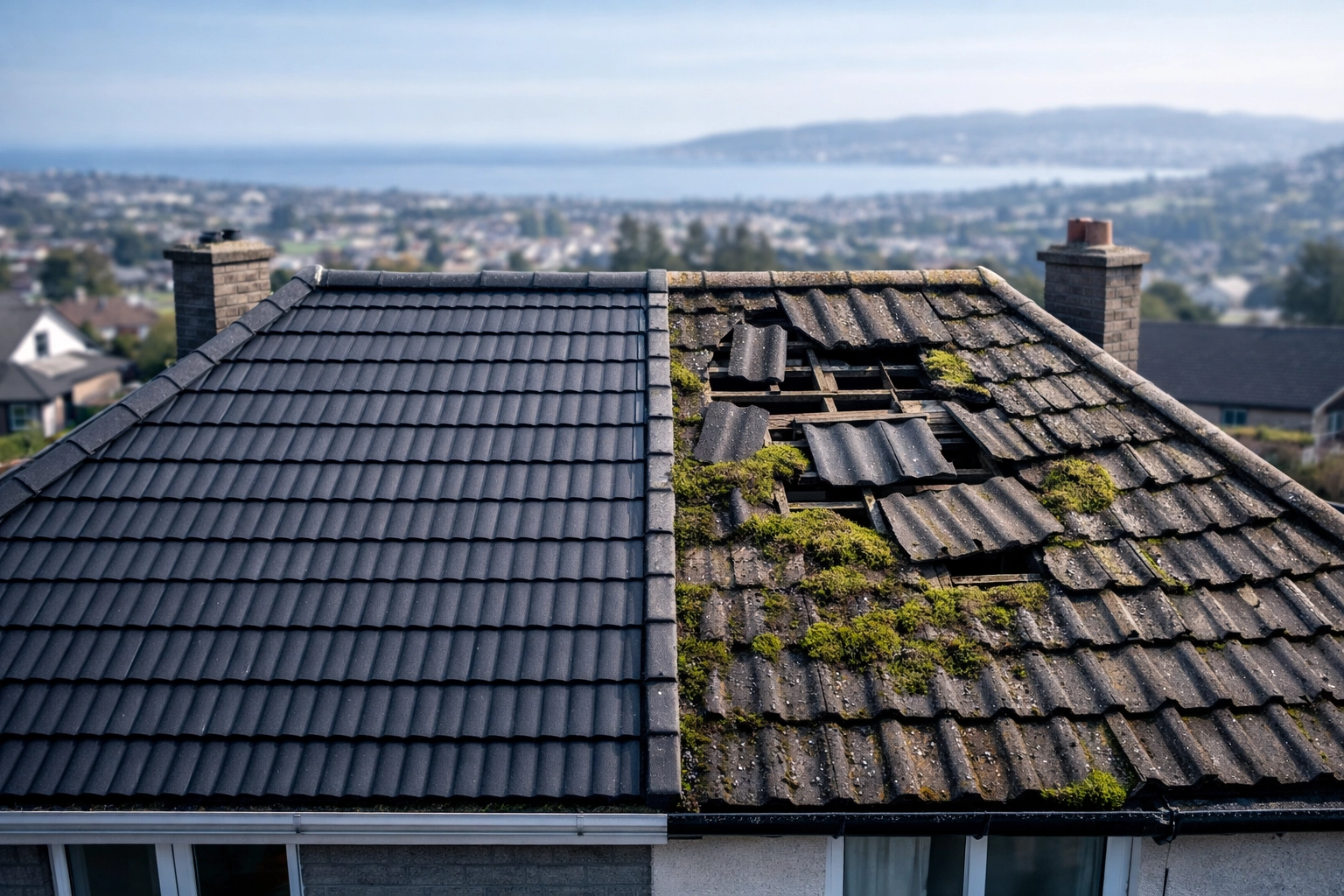
Damaged roof showing missing tiles and moss growth compared to maintained section in Northern Ireland

When Should You Get a Roof Survey?

Before buying a property: Always. It's one of the best investments you can make during the buying process.

Before selling: Get ahead of buyer concerns and demonstrate transparency.

After a storm: If you've had high winds or heavy rain and suspect damage, book a survey quickly to assess and prevent further issues.

Every 5–10 years: Regular inspections catch small problems before they become expensive emergencies.

If you notice warning signs: Leaks, damp patches, moss growth, sagging, or poor ventilation all warrant a professional inspection.

What Happens After the Survey?

Once we've completed your roof survey, we provide a detailed written report with photos, defect identification, and our recommendations. This report will clearly outline:

  • Issues found and their severity
  • Recommended repairs or replacement work
  • Estimated costs
  • Urgency of work (immediate, short-term, or long-term)

If repairs are needed, we'll provide a transparent quote with no hidden costs. If the roof is in good condition, we'll tell you that too: our job is to give you honest, professional advice, not to sell you work you don't need.

Get Your Roof Survey Booked

If you're in Belfast, Bangor, or Newtownards and need a professional roof survey, we're here to help. Whether you're buying, selling, or just want to check your roof's condition, we'll give you clear answers and honest recommendations.

Contact Advanced Construction & Roofing today: https://adv-group.co.uk

A roof survey isn't just paperwork; it's peace of mind. And in Northern Ireland's weather, that's worth its weight in gold.

Slate vs Tile: How to Choose the Best Material for Your Roof Replacement

Replacing your roof is one of the biggest investments you'll make in your property. Get it right, and you'll enjoy decades of protection and curb appeal. Get it wrong, and you're looking at costly repairs, weather damage, and a roof that doesn't suit your home or budget.

The choice between slate and tile roofing often leaves homeowners in Belfast and across Northern Ireland scratching their heads. Both materials have stood the test of time on properties throughout the UK, but they serve different needs, budgets, and architectural styles.

Let's break down exactly what you need to know to make the right choice for your roof replacement.

Understanding Slate Roofing: The Premium Option

Natural slate has roofed buildings across Ireland and the UK for centuries. This natural stone material splits into thin sheets, creating that distinctive, elegant appearance you'll see on period properties and high-end homes throughout Belfast.

Slate delivers unmatched longevity. With proper installation and maintenance, a slate roof will last well over 100 years: often outlasting the building itself. You'll find Victorian-era slate roofs in Belfast that still perform perfectly after 150 years.

The material comes from quarries, primarily in Wales and Spain, though Irish slate was historically common. Each slate tile is a piece of natural stone, meaning no two roofs look exactly alike. The subtle color variations and texture create a premium aesthetic that's hard to replicate.

Understanding Tile Roofing: The Versatile Alternative

Roof tiles come in two main types: clay and concrete. Both have been used extensively across Northern Ireland, offering homeowners more flexibility in design, color, and price point than slate.

Clay tiles deliver that classic terracotta look you'll see on Mediterranean-style properties, though modern clay tiles come in various colors. Concrete tiles offer even more versatility, manufactured in dozens of profiles, textures, and finishes to suit any architectural style.

Tile roofing typically lasts 50 to 70 years: shorter than slate but still a solid long-term investment. The material has evolved significantly, with modern manufacturing producing tiles that perform exceptionally well in Northern Ireland's challenging climate.

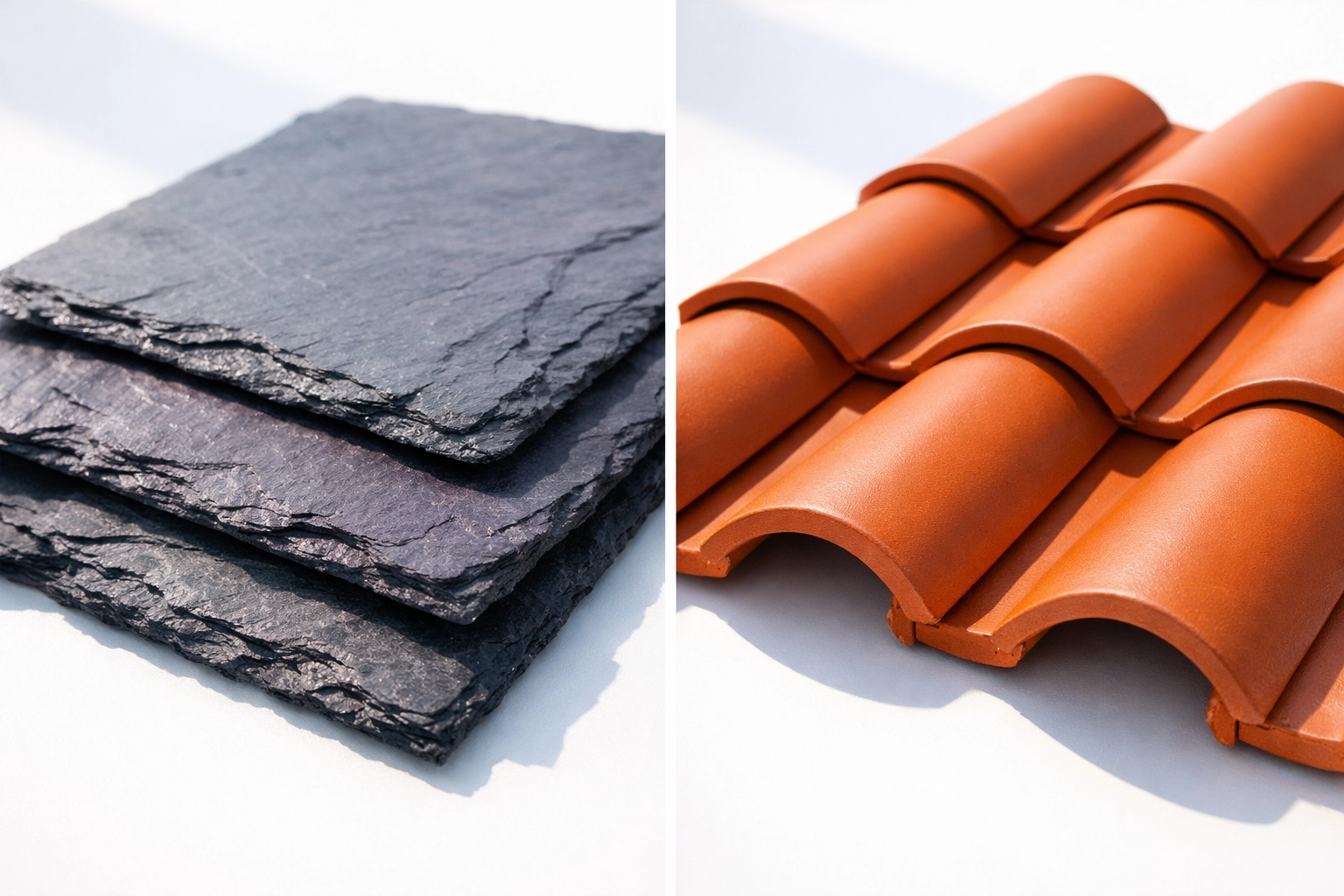
Slate vs tile roofing materials comparison showing texture and color differences

What Will Your Roof Replacement Actually Cost?

Budget matters, and there's no point pretending otherwise. The cost difference between slate and tile is significant, and you need those numbers upfront.

Slate roofing costs £15–£30 per square foot to install. For an average Belfast home, you're looking at £15,000–£40,000+ depending on roof size and complexity. That's a substantial investment, no question about it.

Tile roofing costs £10–£20 per square foot to install. The same Belfast home might cost £10,000–£25,000 to re-roof with quality tiles. That's roughly 30–40% less than slate for the initial installation.

But here's what those numbers don't tell you: lifetime cost calculations change the picture. If your slate roof lasts 100+ years and your tile roof needs replacement after 60 years, the slate effectively costs less per year of service. You'll likely never replace a properly installed slate roof during your ownership: or your children's ownership.

Tile replacement isn't a distant concern either. At the 50-70 year mark, you or future owners will face another £10,000–£25,000 replacement project.

How Long Will Each Material Actually Last?

Durability isn't just about lifespan: it's about performance throughout that lifespan. Both materials can last decades, but they age differently.

Slate roofs require minimal intervention for a century or more. The stone doesn't degrade, rot, or deteriorate in ways that affect performance. Individual slates may crack or slip from fixings over time, but the material itself remains sound. Belfast's Victorian terraces prove this: many still wear their original slate roofs.

Tile roofs deliver 50-70 years of reliable service when properly installed and maintained. Concrete tiles may show some surface wear in harsh weather, and clay tiles can crack under severe frost cycles, but modern manufacturing has significantly improved durability.

The catch? Installation quality matters enormously for both materials. A poorly installed slate roof won't reach 100 years, and a badly fitted tile roof might fail in 30. This is why choosing experienced roofers matters as much as choosing materials.

Weight Considerations: Will Your Roof Structure Cope?

Here's something many homeowners don't consider until they're mid-project: both slate and tile are heavy materials that may require structural assessment.

Natural slate weighs approximately 7.8 lbs per square foot. That's substantial, but most traditionally built Belfast homes were designed to carry slate, so existing structures often cope fine.

Tile weighs 9.6–15.2 lbs per square foot, with clay tiles being roughly 50% heavier than concrete options. This extra weight can be a concern for extensions, conversions, or older buildings where structural capacity isn't certain.

Before committing to either material, request a structural survey. A qualified surveyor will assess whether your roof timbers, walls, and foundations can safely carry the load. Reinforcement is possible but adds cost: sometimes enough to change your material decision.

We've worked on countless Belfast properties where structural limitations ruled out certain materials. Better to know upfront than discover mid-installation that you've got a problem.

Advanced Construction & Roofing Roof Survey Service

How Does Northern Ireland's Climate Affect Your Choice?

Belfast weather doesn't mess about. We face freeze-thaw cycles, heavy rain, strong winds, and everything in between. Your roofing material needs to handle these conditions year after year.

Slate performs exceptionally well in cold, wet climates. The dense stone absorbs minimal water, so freeze-thaw damage is rare. When temperatures plummet and water expands in porous materials, slate simply doesn't have enough absorbed moisture to cause problems. This makes slate ideal for Northern Ireland's climate.

Tile handles our weather differently. Clay tiles perform well but can crack in severe frost if water penetrates them. Concrete tiles are more vulnerable to moisture absorption, which can lead to frost damage over time. Modern tiles incorporate better water resistance, but they'll never match slate's impermeability.

Both materials handle wind well when properly fixed. The key is using appropriate fixings for your location: coastal properties in County Down need different specifications than sheltered Belfast suburbs.

What About Roof Pitch Requirements?

Your roof's angle affects which materials you can use. Some roofs simply aren't suitable for certain materials, regardless of preference.

Slate performs best on roofs with pitches above 20 degrees. You can install slate on shallower pitches with additional waterproofing measures, but it's not ideal. Many Belfast terraces and Victorian properties have steep pitches specifically designed for slate.

Tile works on pitches as low as 15 degrees, giving you more flexibility. This matters for extensions, single-story additions, or modern architectural designs with shallower roof angles.

If your existing roof has a low pitch, tile might be your only practical option between these two materials. Alternatively, you might need to consider flat roofing solutions like EPDM or liquid roofing systems.

Which Material Suits Your Property's Style?

Aesthetics matter. Your roof makes up roughly 40% of your property's visible exterior, so it needs to suit the building.

Slate delivers timeless, elegant appearance that suits period properties, traditional builds, and upmarket contemporary designs. The natural stone has subtle color variations: from dark grey to purple-tinged Welsh slate or green-tinged alternatives. Belfast's Georgian and Victorian architecture looks right with slate because that's what was originally specified.

Tile offers far more design versatility. You'll find tiles in red, brown, grey, black, and various blended finishes. Profiles range from flat and sleek to deep and chunky. Want a Mediterranean look? Clay tiles deliver. Prefer modern minimalism? Smooth concrete tiles work perfectly.

Consider your property's architectural style, your street's character, and planning requirements. Conservation areas in Belfast may restrict your choices, and some developments have covenants specifying roofing materials.

What Maintenance Will You Actually Need?

Both materials are marketed as "low maintenance," but what does that actually mean in practice?

Slate requires minimal ongoing maintenance. Annual inspections to check for slipped or cracked slates, gutter cleaning, and occasional individual slate replacement is typically all you need. The material doesn't degrade, so there's no painting, treating, or surface maintenance. Budget for inspection and minor repairs rather than major maintenance.

Tile needs slightly more attention. Concrete tiles can accumulate moss and algae in Belfast's damp climate, requiring periodic cleaning. Individual tiles may crack and need replacement, particularly in exposed locations. Clay tiles are more maintenance-free but cost more initially. Plan for inspection, cleaning, and occasional tile replacement.

Neither material requires the regular painting and treatment that timber roofing demands, so both genuinely offer low maintenance compared to other options.

Making Your Decision: Which Material Is Right for You?

You've got the information: now let's make this decision practical.

Choose slate if you:

  • Want the longest possible lifespan with minimal maintenance
  • Own a period property where slate suits the architecture
  • Can afford the higher upfront investment
  • Have adequate roof structure to carry the weight
  • Value the premium, natural aesthetic
  • Plan long-term ownership where lifetime costs matter

Choose tile if you:

  • Need to manage initial installation costs
  • Want more design flexibility and color options
  • Have a lower-pitch roof that suits tile better
  • Prefer the appearance of tile for your property style
  • Don't mind replacing the roof again in 50-70 years
  • Need faster installation with lower labor costs

There's no wrong choice here: only the wrong choice for your specific situation, budget, and property.

Get Expert Guidance for Your Roof Replacement

Choosing materials is just the first step. Proper installation determines whether your new roof delivers its full potential lifespan and performance.

At Advanced Construction & Roofing, we've installed both slate and tile roofs across Belfast and throughout Northern Ireland for years. We'll assess your property's structure, discuss your budget honestly, and recommend materials that genuinely suit your needs: not just what's easiest for us to install.

Request a free survey and quotation. We'll visit your property, assess your existing roof, discuss your options, and provide clear, transparent pricing for both slate and tile solutions. No pressure, no surprises, just honest advice from experienced professionals.

Contact Advanced Construction & Roofing today at https://adv-group.co.uk to discuss your roof replacement. Let's make sure your investment delivers decades of reliable protection and lasting value.