
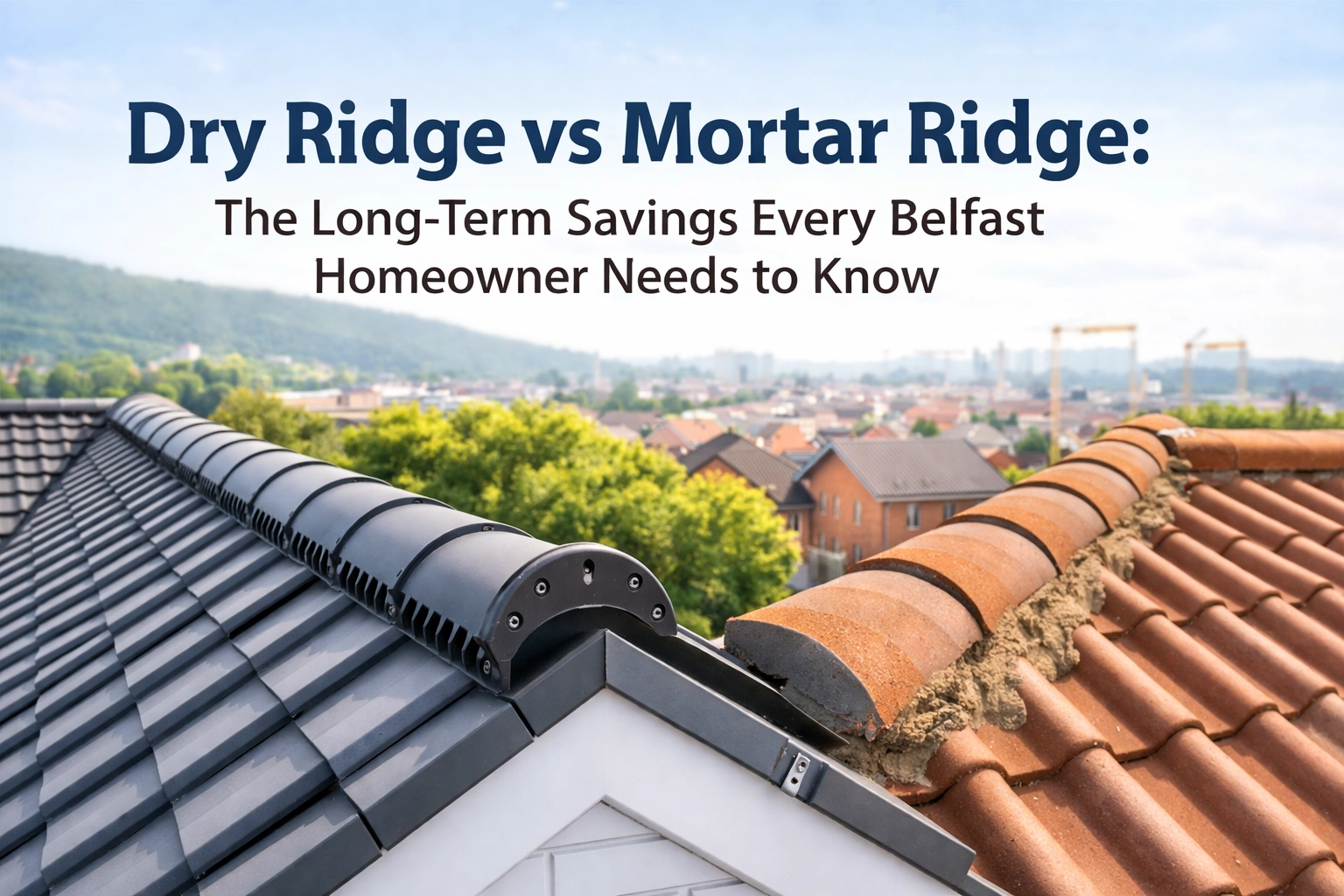

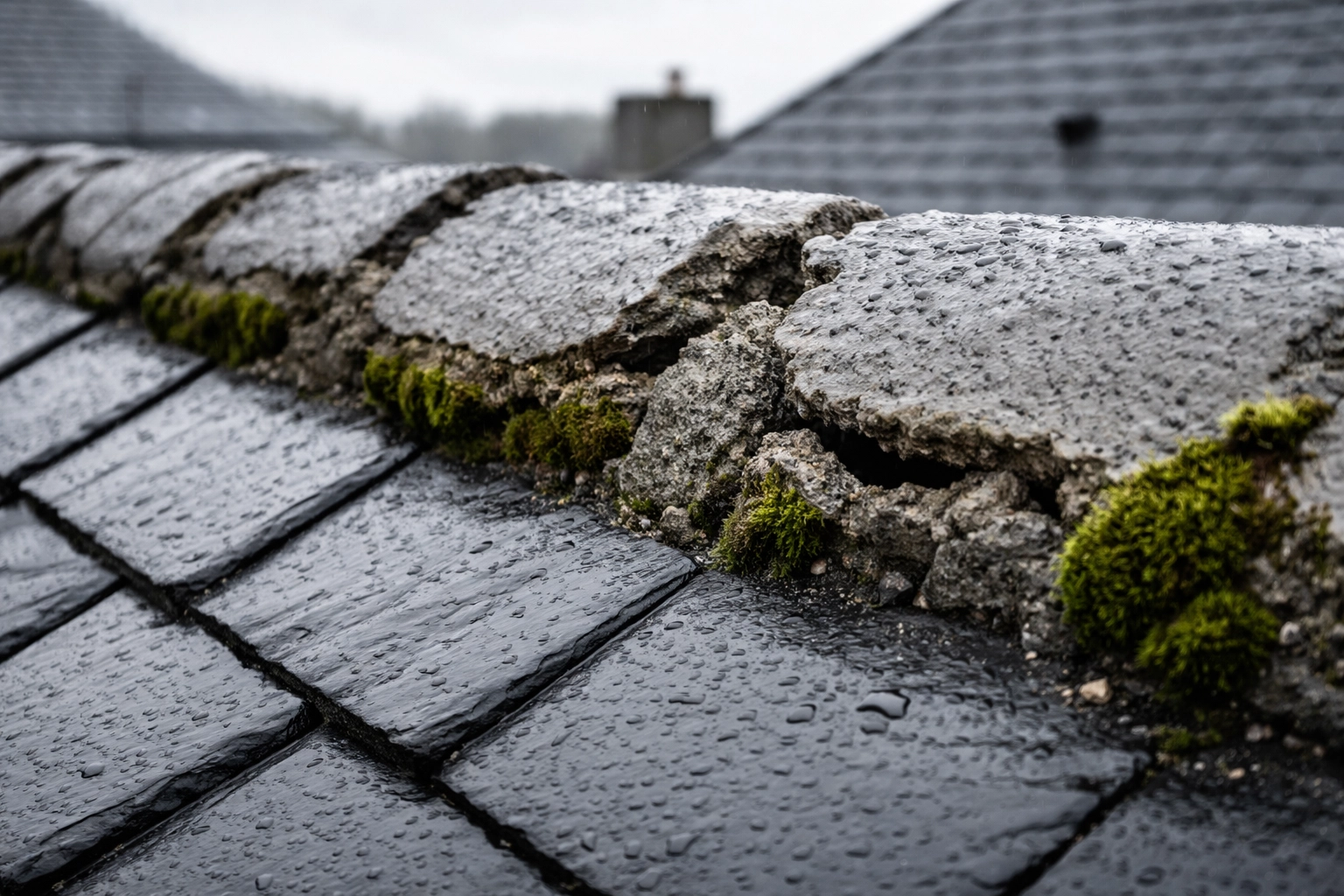
You've seen it before. That crumbling line of cement running along the top of your neighbour's roof. The gaps where mortar has cracked and fallen away. The dark patches where water has started seeping in.
If you're a Belfast homeowner, this isn't just an eyesore, it's money draining from your bank account.
The choice between dry ridge and mortar ridge isn't just about aesthetics or following the latest roofing trends. It's a financial decision that will impact your household budget for the next 20 to 30 years. And in Belfast's notoriously damp climate, that decision matters more than you might think.
Let's break down the real numbers and show you exactly why dry ridge systems are saving Belfast homeowners hundreds of pounds over the long term.
Why Does Mortar Fail in Belfast's Climate?
Here's the uncomfortable truth about mortar ridges: they were never designed for Belfast weather.
Belfast experiences an average of 157 rainy days per year. That's nearly half the calendar spent with moisture attacking your roof. Add in our freeze-thaw cycles during winter months, and you've got a recipe for mortar destruction.
Here's what happens to mortar in our climate:
- Water penetration: Rain seeps into tiny cracks in the mortar
- Freezing expansion: When temperatures drop, that water freezes and expands
- Cracking and crumbling: The expansion forces the cracks wider
- Repeat cycle: Every freeze-thaw cycle makes the damage worse
This isn't a question of if your mortar ridge will fail, it's a question of when.
Most mortar ridges in Belfast start showing significant deterioration within 10 to 15 years. Some fail even sooner, especially on exposed properties or those facing the prevailing westerly winds.
The Hidden Costs of Mortar Ridge Maintenance
When you chose a mortar ridge (or inherited one when you bought your property), you didn't just pay for the initial installation. You signed up for ongoing maintenance costs that compound year after year.
Consider what mortar ridge ownership actually costs:
Mortar ridges require waterproofing recoating every other year to maintain their integrity. Skip this maintenance, and you're looking at cracked cement, loose tiles, and eventually water ingress into your roof space.
The installation time alone tells a story. Mortar bedding takes approximately 6 hours per 10 metres of ridge to install properly. That's labour-intensive work that you'll need to pay for again and again when repairs become necessary.
And repairs will become necessary.
Common mortar ridge repair scenarios Belfast homeowners face:
- Repointing cracked sections (typically needed every 5-7 years)
- Replacing fallen ridge tiles after storms
- Emergency repairs when water starts coming through
- Full ridge replacement when damage becomes too extensive
Each of these repairs means scaffolding costs, labour costs, and material costs. Each repair means time off work to let contractors in. Each repair means stress and inconvenience.
Dry Ridge: The Smarter Financial Investment
Now let's talk about the alternative that's transforming how Belfast homeowners think about their roofs.
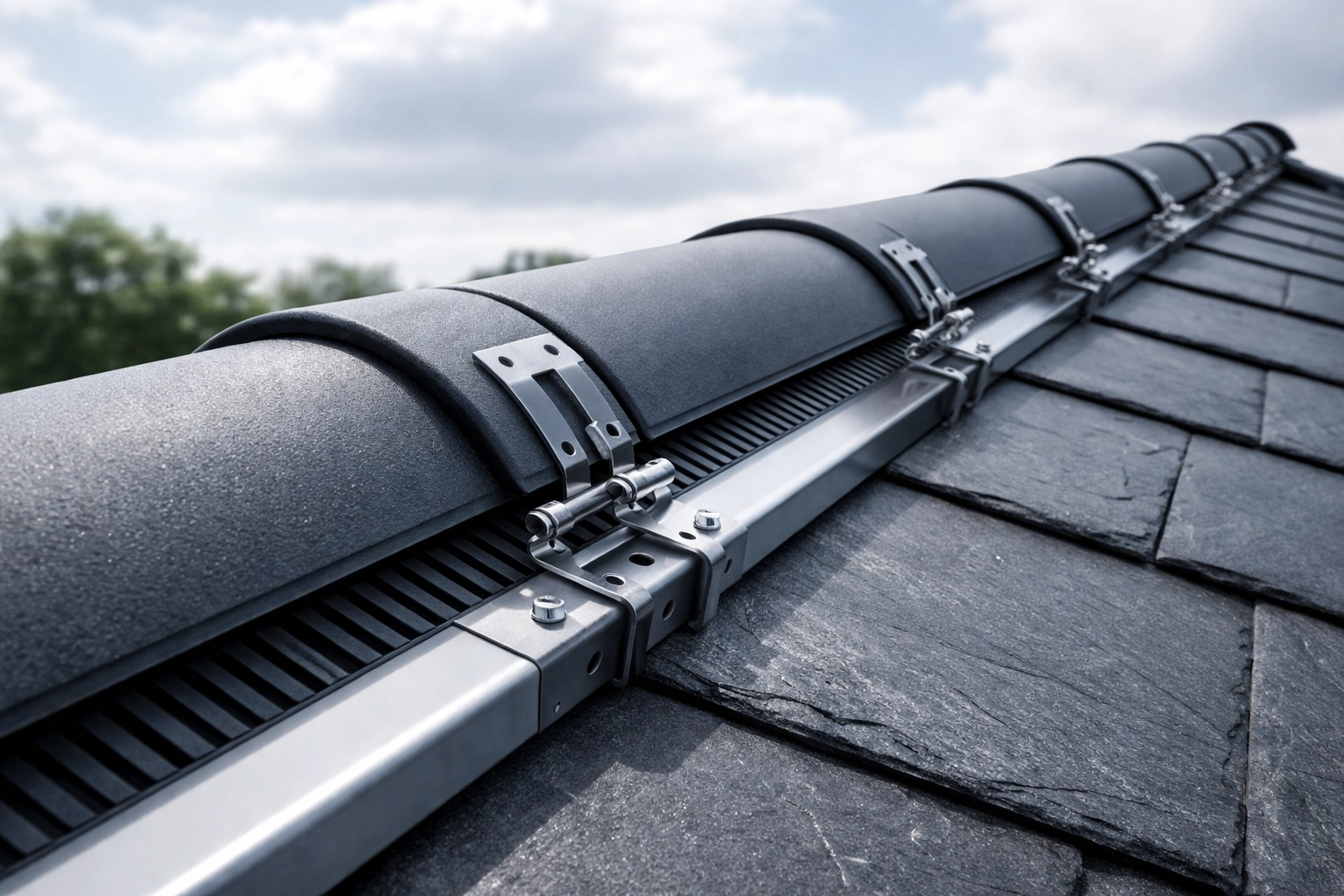
Dry ridge systems use mechanical fixings instead of mortar. Stainless steel or aluminium clips secure your ridge tiles to the roof structure, creating a weatherproof seal without any cement involved.
The key word here? Maintenance-free.
Once a dry ridge system is installed, it requires no check-ups, no recoating, and no regular repairs. The mechanical fixings are designed to last the lifetime of your roof, typically 30 years or more.
Installation is also significantly faster. A dry ridge takes approximately 2.5 hours per 10 metres of ridge compared to 6 hours for mortar bedding. That's a substantial reduction in labour costs right from day one.

Breaking Down the Numbers: What Will You Actually Save?
Let's get specific about the financial benefits. Because when it comes to your household budget, vague promises don't pay the bills.
Over a 20-year period, dry ridge systems can save Belfast homeowners between £400 and £700 compared to mortar ridges.
Here's how that breaks down:
| Cost Factor | Mortar Ridge | Dry Ridge |
|---|---|---|
| Initial installation | Lower | Higher |
| Biennial waterproofing | Required | Not needed |
| Repair frequency | Every 5-7 years | Rarely/never |
| Emergency storm repairs | Common | Uncommon |
| Total 20-year cost | Higher | Lower |
Yes, the upfront cost of a dry ridge system is higher than traditional mortar. But that's where mortar's advantage ends.
Think of dry ridge as paying once, while mortar means paying forever.
The savings become even more significant when you factor in the indirect costs: time spent arranging repairs, potential damage to belongings if leaks occur, and the stress of dealing with roofing emergencies.
How Does Weather Durability Protect Your Wallet?
Belfast's weather doesn't just affect your morning commute: it actively attacks mortar ridges throughout the year.
Dry ridge systems are specifically engineered to handle what our climate throws at them:
The mechanical fixings are designed to flex with natural roof movement caused by temperature changes. Unlike rigid mortar, which cracks under stress, dry ridge components move with your roof structure.
High winds? Dry ridge fixings resist wind uplift far better than mortar, which can loosen over time. After major storms, mortar ridge homeowners often find themselves calling roofers for emergency repairs. Dry ridge homeowners typically don't.
Heavy rain? The design of dry ridge systems channels water away from vulnerable areas, preventing the pooling and penetration that damages mortar installations.
For more information about how wind resistance affects your roof, check out our guide on roof wind resistance in 2026.
When Might Mortar Still Make Sense?
We believe in giving you the complete picture, even when it doesn't favour the more modern solution.
Mortar ridges may still be appropriate in specific situations:
If your property is located in a conservation area with strict planning requirements, traditional mortar might be required to maintain the heritage appearance of your roof. Mortar offers a seamless, traditional aesthetic that some period properties demand.
If you're selling your property within the next few years and the current mortar ridge is in good condition, the cost of switching to dry ridge might not pay back before you sell.
However, for the vast majority of Belfast homeowners planning to stay in their properties long-term, dry ridge represents the smarter financial choice.
What Should You Do Next?
If you're concerned about your current ridge condition or you're planning a roof replacement, now is the time to consider your options carefully.
Request a professional roof survey to assess your current ridge condition and get an honest assessment of whether upgrading to dry ridge makes financial sense for your specific situation.
At Advanced Construction & Roofing, we've helped hundreds of Belfast homeowners make informed decisions about their roofing investments. We'll give you a straightforward assessment: no pressure, no obligation.
Contact us today for a comprehensive roof survey and find out exactly what state your ridge is in. We'll show you the evidence with detailed photos and explain your options in plain English.
Don't wait until water starts coming through your ceiling. Don't wait until emergency repairs cost you twice what planned maintenance would have. Take control of your roofing costs now.
Call Advanced Construction & Roofing today. Your future self; and your bank account: will thank you.